Why Secure Coding Matters
Enterprises now run hundreds of services,
APIs, data pipelines, and event-driven
workloads that change daily. That pace is
good for feature velocity, but it also
multiplies the number of places where one
insecure coding decision can expose data,
break authorization boundaries, or create
code execution risk. In most incidents,
attackers do not need zero-days. They reuse
predictable weaknesses that are already
mapped in common frameworks such as OWASP
Top 10, including A01 Broken Access Control,
A03 Injection, A05 Security
Misconfiguration, and A10 Server-Side
Request Forgery.
Leadership teams often invest in scanners,
WAF policies, cloud controls, and incident
response, but they still discover the same
coding flaws in sprint after sprint.
Traditional tooling finds defects late,
usually after merge or deployment, when
remediation costs are higher and release
pressure is strongest. Secure code training
closes that gap by changing behavior at the
source: the design and implementation
choices developers make before risky code is
committed. That is why mature programs treat
training as a control that must produce
measurable outcomes, not as awareness
content that only proves participation.
The business impact is direct. Fewer severe
defects reaching production means lower
incident likelihood, reduced time spent on
emergency patching, and stronger customer
trust during vendor security assessments.
For CISOs and engineering directors, this
translates into clearer board-level
reporting: not "500 engineers completed a
module," but "injection-style coding errors
dropped by 38% in target repositories over
two quarters." That shift from activity
metrics to risk metrics is the reason
enterprise secure code training deserves a
dedicated strategy and an execution model
designed for software teams.
What Traditional Training Gets Wrong
Most secure coding programs fail because
they are optimized for content delivery, not
for engineering behavior change. They use
annual videos, static e-learning decks, and
short multiple-choice quizzes that test
memory, not implementation. Developers can
pass these courses without opening an IDE,
writing a unit test, or debugging a single
vulnerable branch. That mismatch creates
confidence in reporting dashboards while
leaving real code quality unchanged.
The second failure is context. A generic
deck that explains SQL injection or broken
authentication in abstract terms does not
reflect how your teams actually build
services. Engineers need realistic
constraints: deadlines, legacy code,
framework quirks, and integration pressure.
Without context, lessons do not transfer to
day-to-day pull requests. The result is
familiar in AppSec programs: same bug class,
same team, same remediation loop.
The third failure is measurement. Legacy
programs report completion percentage,
average quiz score, and policy attestation.
Those are useful for audit evidence, but
they do not answer operational security
questions. Did developers stop concatenating
SQL in query builders? Did authorization
checks move from controller middleware into
enforced service-level rules? Did API teams
eliminate insecure deserialization patterns
in critical paths? If your training stack
cannot answer these questions, it is a
compliance artifact, not a security control.
Finally, traditional models often separate
security learning from engineering
leadership. Security teams purchase courses,
HR assigns completion deadlines, and
managers only see red or green completion
statuses. No one owns the link between
learning and code quality outcomes.
Effective secure code training requires
shared ownership: security teams define risk
priorities, engineering leaders enforce
execution, and data from practical labs
feeds both groups.
How SecDim Solves This
SecDim is designed as a developer-first,
measurable secure code training platform.
Instead of watching passive content,
engineers solve realistic attack-and-defence
labs that reflect how vulnerabilities are
introduced and fixed in production systems.
Learners use familiar workflows, including
cloning repositories, running tests,
patching vulnerable code, and validating
remediations. This format creates practice
under the same pressure patterns found in
delivery environments.
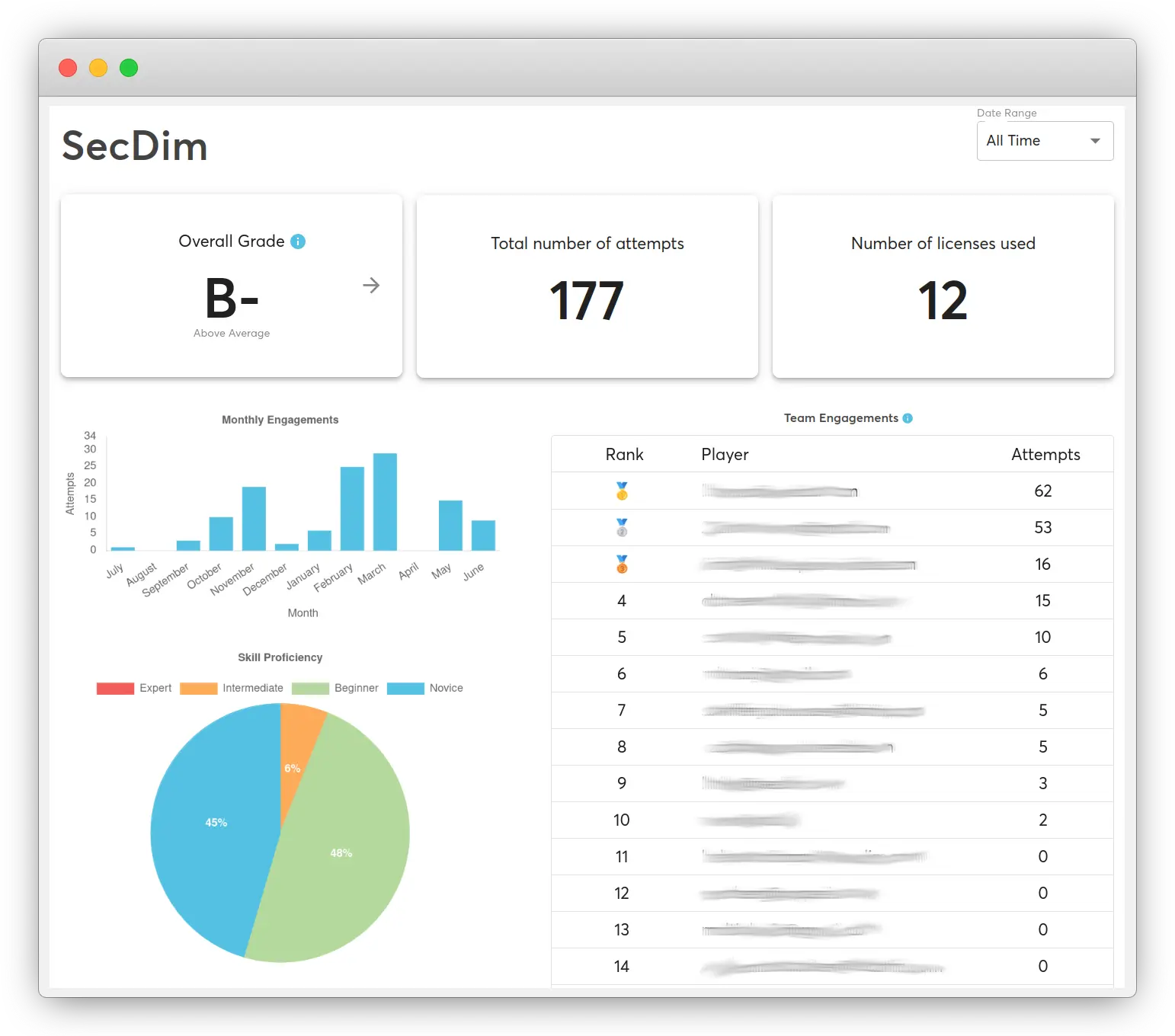
For security leaders, the core advantage is
measurable behavior data. The platform does
not stop at completion status. It tracks how
developers approach vulnerabilities, which
defensive patterns they apply, and how
reliably they prevent regression in repeat
scenarios. That data can be aggregated by
team, role, and topic to support risk
reviews, security program planning, and
board reporting.
For engineering managers, rollout is
practical. Teams can start with baseline
challenges aligned to high-risk categories,
then progress into role-specific pathways
for API engineers, backend teams, full-stack
teams, and platform teams. Managers can pair
this with existing SDLC controls such as
SAST, code review checklists, and release
gates. The outcome is a single learning
loop: identify vulnerability patterns,
practice secure fixes, and verify
improvement in both labs and production
repositories.
If you run instructor-led programs, SecDim
also supports security champions and
trainers who need structured lab execution.
You can see details on
SecDim for trainer-led secure coding
programs, and evaluate enterprise deployment
options on the
secure code learning platform page. When you are ready to evaluate fit for
your environment, use the
secure code training demo workflow
to define pilot scope, metrics, and success
criteria.
Move Beyond Completion Metrics
See how your organization can run secure
code training as a measurable control
with clear behavior outcomes for
engineering and security leadership.
Real-World Example: Injection in an Internal
Admin API
Consider an internal admin endpoint used by
operations teams to search users by email.
Because the endpoint is "internal," the team
skips strict validation and builds SQL using
string concatenation. During a red-team
exercise, an attacker chains compromised
credentials with this endpoint and extracts
privileged user data. This is a common
pattern mapped to OWASP A03 Injection,
especially when trust assumptions around
"internal" traffic replace secure coding
controls.
// Vulnerable: SQL query built from unsanitized input
app.get("/admin/users", async (req, res) => {
  const email = req.query.email;
  const sql = `SELECT id, email, role FROM users WHERE email = '${email}'`;
  const rows = await db.query(sql);
  res.json(rows);
});
In training, developers exploit this
endpoint first so the risk is tangible. They
see how payloads like
' OR '1'='1
affect query logic, then correlate the
impact with data exposure and privilege
escalation paths. That attack step matters:
teams that only read about injection often
underestimate exploitability in their own
services.
// Fixed: parameterized query and explicit field allowlisting
app.get("/admin/users", async (req, res) => {
  const email = String(req.query.email || "").trim();

  if (!/^[^\s@]+@[^\s@]+\.[^\s@]+$/.test(email)) {
    return res.status(400).json({ error: "Invalid email format" });
  }

  const sql = "SELECT id, email, role FROM users WHERE email = $1";
  const rows = await db.query(sql, [email]);
  return res.json(rows);
});
SecDim labs then require a defensive
completion path: implement a parameterized
query, validate input format, run regression
tests, and pass attack-oriented test cases.
Completion only counts when exploit traffic
no longer succeeds and business logic still
works. This "attack to test to patch"
sequence directly trains practical behavior
that translates to production pull requests.
The same scenario can be extended into other
OWASP categories. Teams add authorization
checks to ensure only privileged roles can
call the endpoint (A01 Broken Access
Control), enforce audit logging for
sensitive access (A09 Security Logging and
Monitoring Failures), and validate outbound
data handling to reduce accidental leakage.
By connecting one defect to adjacent control
failures, secure code training becomes a
system-level exercise rather than a single
bug fix.
SecDim vs Traditional Secure Coding Training
| Evaluation Area |
Traditional Training |
SecDim Secure Code Training
|
|
Passive slides vs hands-on
labs
|
Annual slide decks and video
modules with limited
practice.
|
Live attack-and-defence labs
where engineers debug,
exploit, and patch real
code.
|
|
Completion metrics vs
behavior metrics
|
Completion percentage and
quiz score reporting.
|
Behavioral evidence
including exploit
resistance, fix quality, and
repeat-defect reduction by
team.
|
|
Knowledge vs injection-rate
reduction
|
Focus on awareness and
terminology retention.
|
Focus on measurable
reduction of injection and
related coding defects in
engineering workflows.
|
|
Static compliance vs
measurable control
effectiveness
|
Audit-ready attestations
with weak linkage to
operational security
outcomes.
|
Evidence of control
effectiveness tied to real
vulnerability classes and
remediation behavior over
time.
|
| Role alignment |
One-size-fits-all training
for all technical roles.
|
Role-specific pathways for
platform, API, backend,
frontend, and DevSecOps
teams.
|
| Leadership visibility |
Reports oriented around LMS
administration.
|
Dashboards built for
security and engineering
leadership decision-making.
|
How It Works
A practical enterprise rollout does not
require replacing your existing AppSec
program. SecDim is most effective when
integrated with your current delivery and
governance model. A typical launch sequence
includes the following steps:
-
Define risk priorities.
Security and engineering leadership
identify the vulnerability classes that
create the highest business risk in your
environment, often using incident data,
bug backlog trends, and threat modeling
outcomes.
-
Run baseline assessments.
Teams complete initial labs to establish
current behavior across high-priority
topics such as injection, broken access
control, authentication, and API input
handling.
-
Assign targeted pathways.
Learners are mapped to role-specific
challenge sets so each team spends time
on vulnerabilities they are most likely
to introduce in production.
-
Measure fix quality.
Training outcomes capture not only
whether a challenge is solved, but also
whether the remediation pattern is
robust and resistant to variant attacks.
-
Review with leadership.
Engineering managers and security
leaders review behavior trends, identify
teams needing support, and prioritize
follow-up labs based on observed
weaknesses.
-
Expand to continuous
learning.
Successful pilots evolve into quarterly
or release-aligned cycles, turning
secure code training into a consistent
capability rather than an annual event.
This model supports both enterprise security
programs and trainer-led enablement.
Organizations that rely on internal
champions can pair the same labs with
facilitator workflows from
SecDim for security trainers, while central teams can evaluate broader
deployment features from
the platform overview for companies.
FAQ
What is secure code training?
Secure code training teaches
developers to identify, exploit, and
remediate vulnerabilities in working
code so they build durable defensive
habits instead of memorizing theory.
How is enterprise secure code
training different from awareness
programs?
Enterprise secure code training is
tied to measurable engineering
outcomes. It focuses on defect
reduction in real workflows, while
awareness programs usually focus on
policy understanding and completion.
How do secure coding labs support
compliance requirements?
Labs provide practical evidence that
teams can apply required controls in
code. This complements compliance
attestations with operational proof
of secure behavior.
What metrics should CISOs track for
secure code training?
Useful metrics include repeated bug
class reduction, exploit resistance,
remediation quality, and trend data
by team or product area. Completion
rates alone are insufficient.
Can secure code training fit busy
engineering teams?
Yes. Programs are most effective
when delivered in focused sessions
aligned to sprint cadence, with
role-specific labs that map directly
to active engineering
responsibilities.
How do we start a pilot with SecDim?
Start by defining target teams,
high-priority vulnerability classes,
and success criteria. Then
book a demo for secure code
training
to design a pilot with measurable
milestones.
Ready to Run Secure Code Training That
Produces Measurable Outcomes?
Replace passive training with practical
labs and behavior-based reporting that
both engineering leadership and security
teams can trust.