
NGINX2Root Developer Security Challenge
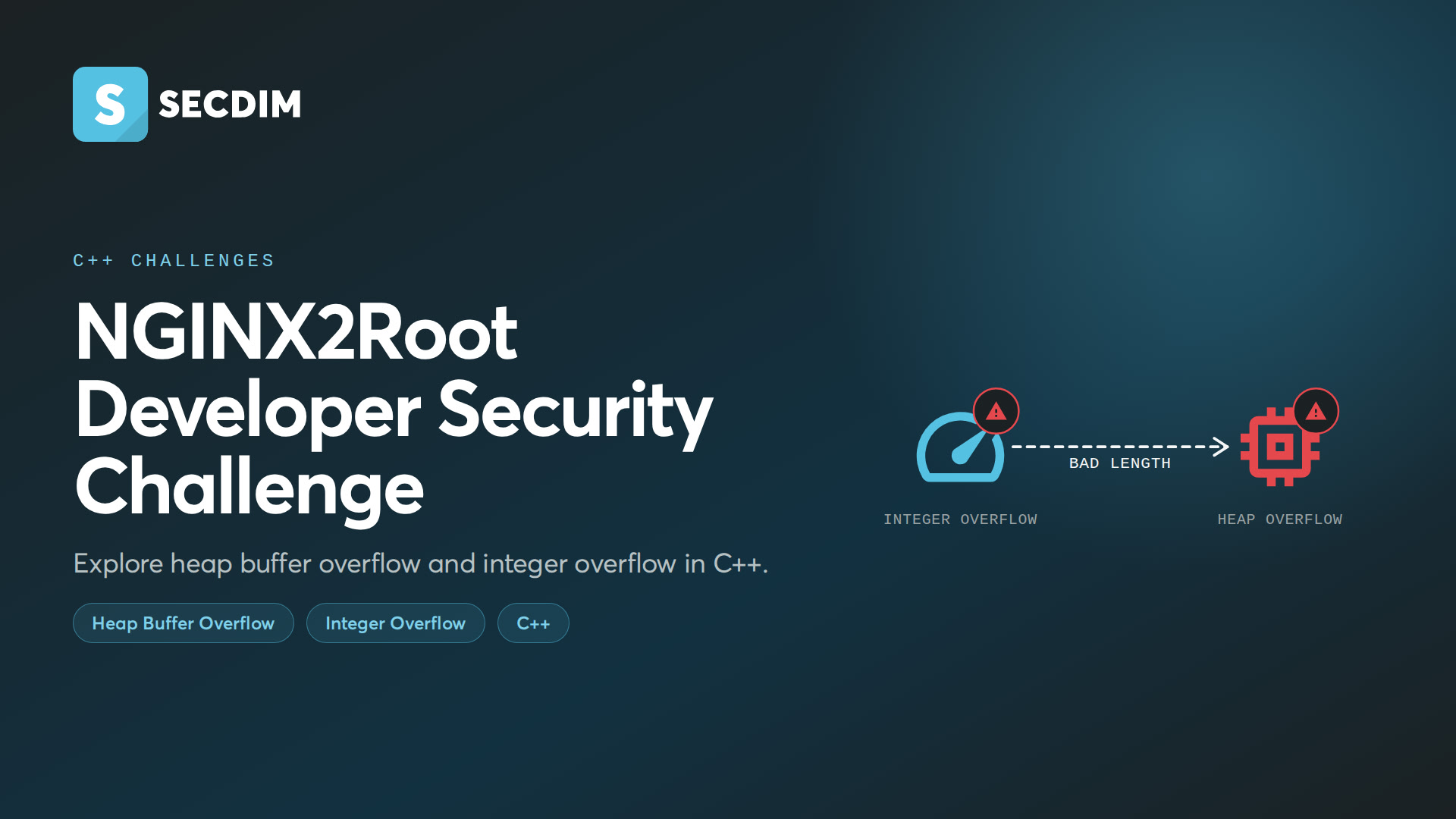
On 18 November 2026, NGINX2Root was disclosed: a set of nginx vulnerabilities that can lead to remote code execution.
CVE-2026-123007 was particularly widespread, affecting nginx 1.9.5 through 1.31.8 with HTTP/2 enabled. An integer overflow in HTTP/2 flow-control calculations resulted in nginx writing outside a buffer on the heap.
Security researchers showed how an unauthenticated attacker could use this to run malicious code on nginx. This could be chained with a separate Linux kernel flaw to gain root access on the host.
NGINX2Root highlights the dangers of memory corruption.
A heap buffer overflow is one such instance: a program writes beyond the memory it reserved on the heap, overwriting what was stored next to it. Any C or C++ program that copies data into a fixed-size buffer without a length check can be at risk of this bug.
Our Heap Buffer Overflow.cpp and Integer Overflow II.cpp challenges let you explore both of these vulnerabilities in C++.
Think you can fix the security bugs? Try them now.
 Heap Buffer Overflow.cpp on SecDim Play: Play - SecDim
Integer Overflow II.cpp on SecDim Play: Play - SecDim