
Fuzzing with AI - New Course on SecDim Learn
Code review, static analysis, and example-based unit tests all work from cases a developer or reviewer could imagine ahead of time. Real bugs tend to hide in the inputs no one wrote a test for.
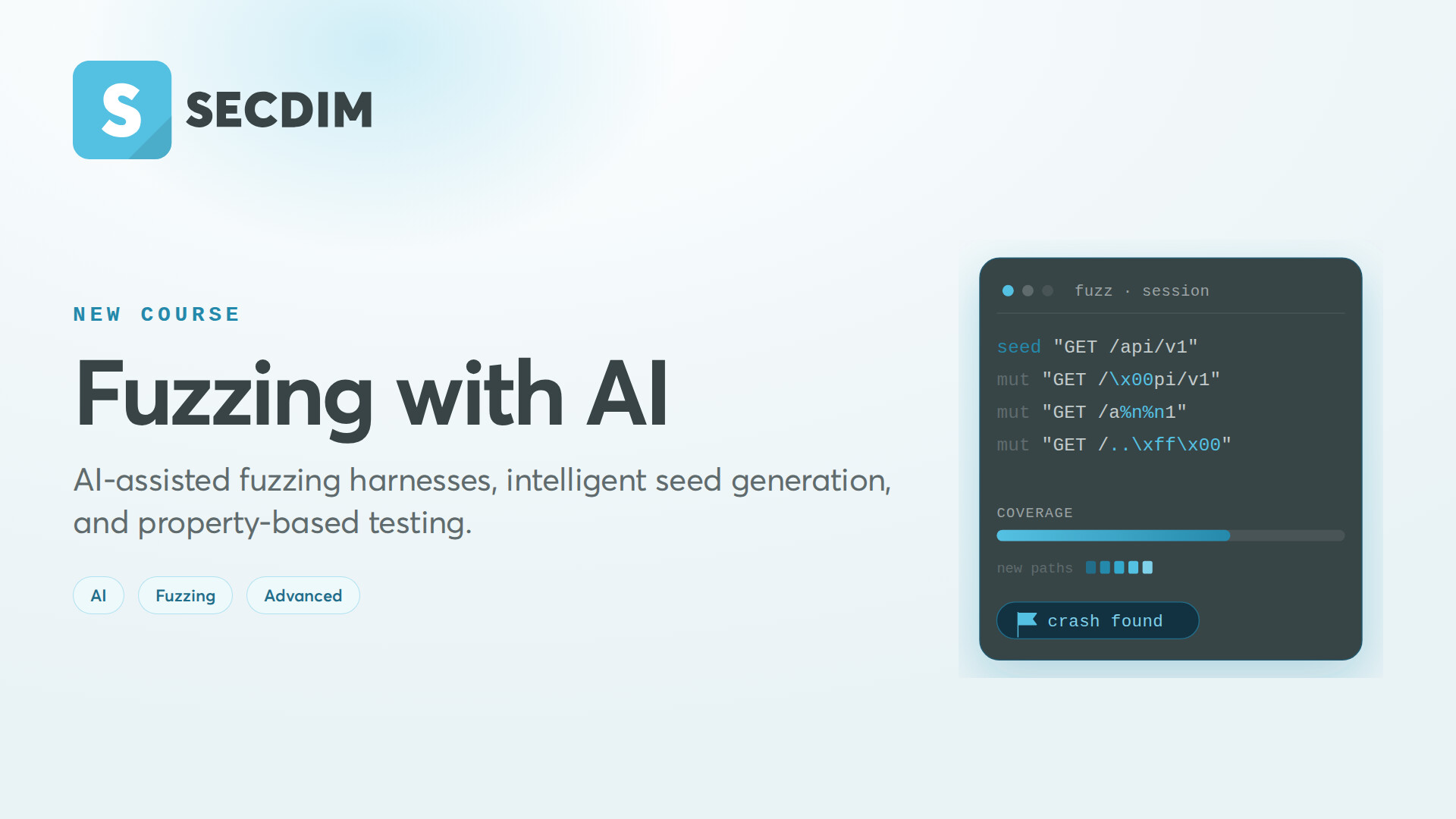
Fuzzing takes the opposite approach. You point a fuzzer at a target, feed it large volumes of generated and mutated input, and watch which inputs reach new code paths or trigger a crash. Over time it reaches parts of the program hand-written tests never touch.
We released Fuzzing with AI on SecDim Learn to teach this from first principles rather than tool trivia. It is an advanced course covering coverage-guided fuzzing, property-based testing, and API fuzzing, and it shows where AI genuinely helps with the setup without pretending it replaces the security work.
The course is hands-on and aimed at developers and security engineers who want to add fuzzing to real projects. It covers how to build a harness, choose and improve a seed corpus, read fuzzer output, and triage what the fuzzer finds.
Topics covered include:
-
Coverage-guided fuzzing fundamentals
-
Property-based testing
-
API fuzzing
-
Writing and generating fuzz harnesses
-
Building and refining seed corpora
-
Reading fuzzer output and triaging findings
-
Using AI to draft harnesses, corpora, and candidate properties
-
Wiring fuzzing into a CI pipeline
The course includes practical labs that run several of these techniques against real targets, so you finish with a workflow you can reuse.
If you write code and rely on tests to catch bad input, fuzzing is the discipline that covers the cases you did not anticipate.
Take the course here: Fuzzing with AI - SecDim Learn