
Play AppSec WarGames
Want to skill-up in secure coding and AppSec? Try SecDim Wargames to learn how to find, hack and fix security vulnerabilities inspired by real-world incidents.

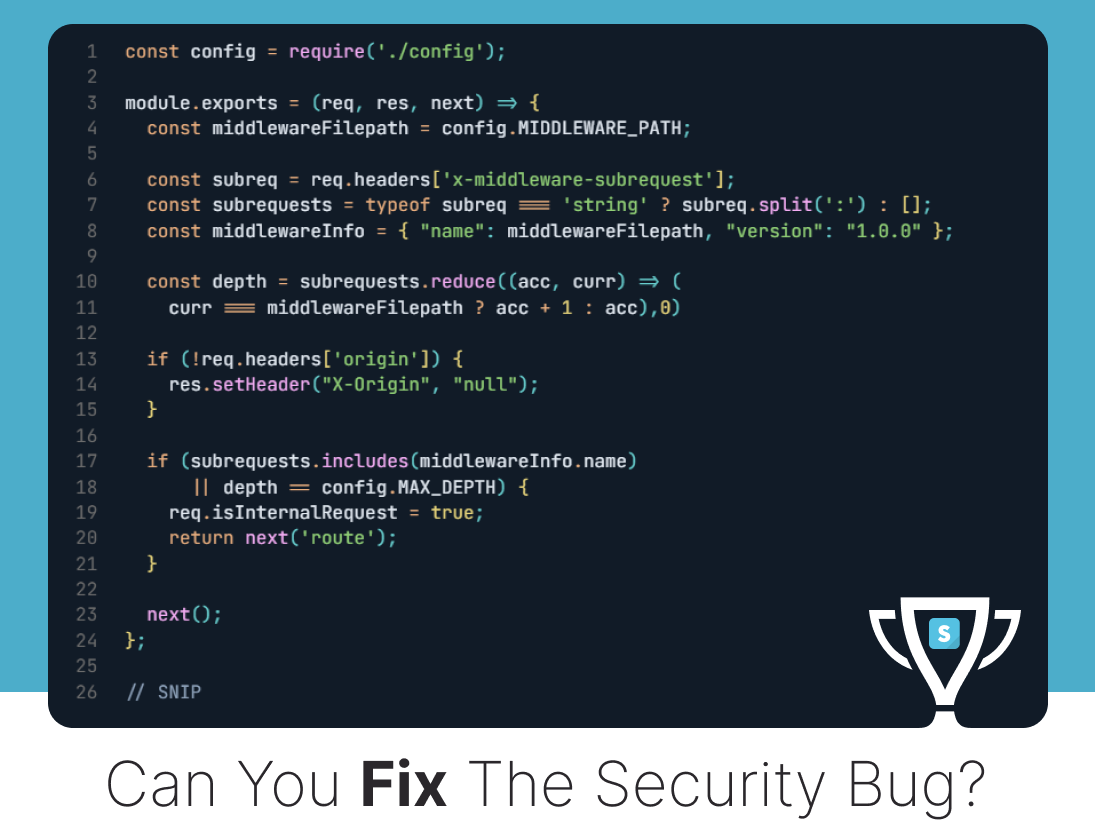
In March 2025, security researchers Rachid Allam and Yasser Allam publicly disclosed a critical vulnerability identified as CVE-2025-29927, affecting Next.js—a widely used React framework for building full-stack web applications. This vulnerability allowed attackers to bypass middleware-based authorization checks, potentially granting unauthorized access to protected routes and sensitive data.
Next.js middleware relies on an internal header named x-middleware-subrequest to prevent recursive middleware invocations and infinite loops. However, due to insufficient validation, attackers could manipulate this header, causing middleware logic to be skipped entirely. This bypass rendered critical security checks such as authorization and cookie validation ineffective.
const config = require('./config');

module.exports = (req, res, next) => {
  const middlewareFilepath = config.MIDDLEWARE_PATH;

  const subreq = req.headers['x-middleware-subrequest'];
  const subrequests = typeof subreq === 'string' ? subreq.split(':') : [];
  const middlewareInfo = { "name": middlewareFilepath, "version": "1.0.0" };
  const depth = subrequests.reduce((acc, curr) => (curr === middlewareFilepath ? acc + 1 : acc),0);

  if (!req.headers['origin']) {
    res.setHeader("X-Origin", "null");
  }

  if (subrequests.includes(middlewareInfo.name) || depth == config.MAX_DEPTH) {
    req.isInternalRequest = true;
    return next('route');
  }

  next();
};
This middleware logic allowed attackers to craft requests with spoofed x-middleware-subrequest headers, effectively skipping essential middleware checks.
Next.js maintainers quickly responded by releasing patches addressing this vulnerability in versions 12.3.5, 13.5.9, 14.2.25, and 15.2.3, ensuring swift mitigation for affected users.
We made a challenge reproducing this vulnerability.
It is available on our Weekly Incident game for 2 weeks.
Available languages:
Want to skill-up in secure coding and AppSec? Try SecDim Wargames to learn how to find, hack and fix security vulnerabilities inspired by real-world incidents.

Join our secure coding and AppSec community. A discussion board to share and discuss all aspects of secure programming, AppSec, DevSecOps, fuzzing, cloudsec, AIsec code review, and more.
Read more